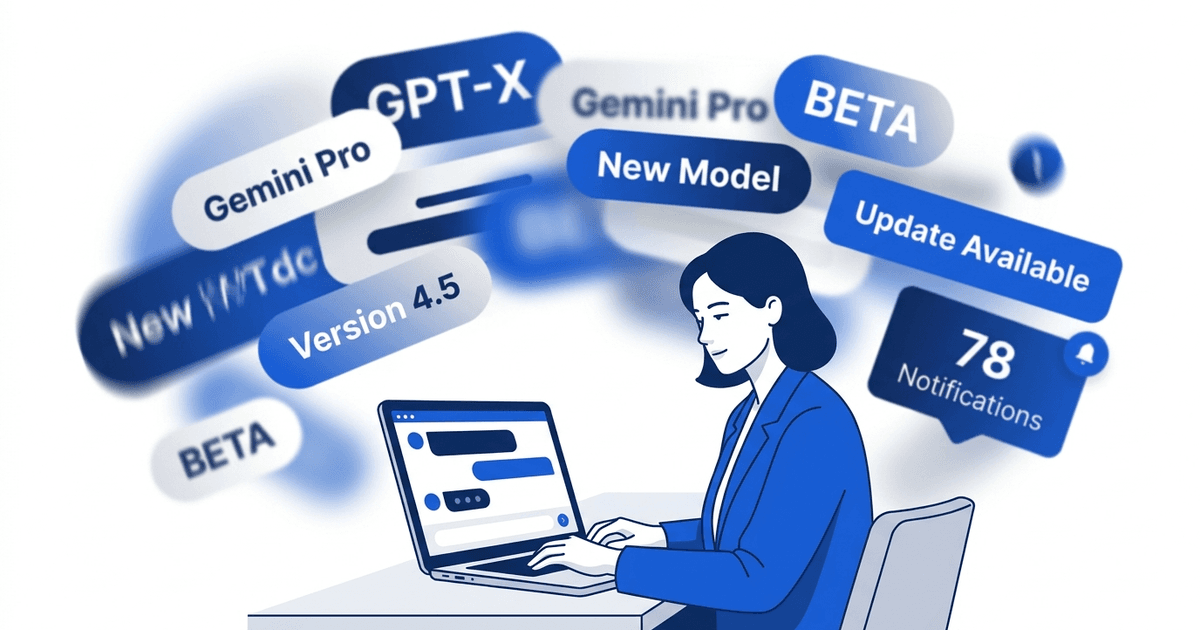
The short version: four major AI models shipped in a single week this month. You do not need to chase any of them. For a business chatbot, the platform you build on matters more than the model of the week — and
BuiltABot is designed to absorb that churn for you.
In one week this September, Anthropic shipped Claude 5.1, OpenAI released GPT-6 Astra, Google unveiled Gemini 3.8 Flash, and Meta pushed a new model too. Four flagship launches. Seven days. If you felt a flicker of “wait, do I need to switch again?” — that feeling has a name.
It is called AI model fatigue, and it is quietly draining time from teams that should be shipping. The instinct to always be on the newest model is understandable and almost always wrong. If you are building or running an AI chatbot, this guide gives you a calmer, more durable way to decide — the same approach we use to run BuiltABot.
The punchline up front: stop picking models, start picking a platform. A platform like BuiltABot lets you train an assistant on your own content and runs it on a maintained model, so you inherit the improvements without rebuilding every eleven days. You can try it free for 14 days.
TL;DR: Stop Chasing Models
- Major model releases now land roughly every 11 days, down from ~37 in 2023.
- For a customer-facing chatbot, the accuracy of your content matters more than the last few benchmark points.
- Every model switch has hidden QA costs: re-testing prompts, re-validating accuracy, tone, and safety.
- The durable move is a model-agnostic platform that upgrades the model for you.
- BuiltABot does exactly this — plans from $29.99/month, 14-day free trial.
What Is AI Model Fatigue?
AI model fatigue is the burnout and decision paralysis that comes from trying to track every new model, capability claim, and price change. The pace is the problem: the median interval between major model drops compressed from about 37.5 days in 2023 to roughly 11 days in 2026.
At that cadence, “evaluate each new model” is not a task — it is a full-time role. For a small business or a lean marketing team, the constant comparison work crowds out the thing that actually moves the needle: getting a working assistant in front of customers and keeping its content sharp.
The Week Four Models Shipped
This month made the problem concrete. Anthropic opened the week with Claude 5.1, billed as a leap for coding and knowledge work, with cache reads priced at a quarter of the prior generation. Mid-week, Meta and Google answered with new models emphasizing coding and agentic tasks. Then OpenAI shipped GPT-6 Astra, leaning into cybersecurity and computer-use skills.
Any one of these would have been a headline a year ago. Four in a week is the new normal. And here is the trap: none of it changes the right answer for a typical website chatbot that answers questions from your knowledge base.
Why Chasing Every Release Is a Trap
Switching models looks free because the API call barely changes. It is not free. Every switch quietly costs you:
- Prompt re-testing — different models react differently to the same instructions.
- Accuracy re-validation — you have to confirm answers against your content did not regress.
- Tone and brand checks — voice can drift between models.
- Safety and compliance re-runs — mandatory for regulated or customer-facing use.
Multiply that by a release every eleven days and you are running a permanent QA project for a benefit your visitors will rarely notice. The winners are the teams that decided which capability threshold their product needs and stopped re-litigating it every few weeks.
Skip the Model Race Entirely
Train an assistant on your own content and let BuiltABot run it on a maintained model — no benchmarking project required. Start free for 14 days.
Here is the mental shift that ends model fatigue: your investment should live at the platform layer, not the model layer.
The model changes every couple of weeks. But your trained assistant — its knowledge, personality, integrations, and the setup work you put in — is stable. A model-agnostic platform keeps your build separate from the underlying model, so it can upgrade or swap the model behind the scenes without you rebuilding anything.
That is the whole game during a release frenzy. You stop asking “which model is best today?” and start asking “which platform will keep me on a good model without making it my problem?” If you are weighing options, our guide to a no-code chatbot builder and our breakdown of training a chatbot on your own data are good next reads.
How to Actually Choose (5 Questions)
Ignore the benchmark charts. Ask these five questions instead:
- What is the job? Support deflection, lead capture, appointment booking? Start from the outcome. See lead generation and support automation guides.
- Can it train on my content? The assistant is only as good as the knowledge behind it.
- Who manages the model? If the answer is “you,” you have signed up for permanent model fatigue.
- What does it cost to run? Predictable pricing beats chasing per-token deals across providers.
- How fast can I ship? A working bot this week beats a perfect model next month.
How BuiltABot Handles Model Churn
BuiltABot is built for exactly this environment. You upload your documents or point us at your website, shape the assistant's tone and behavior, and embed it on your site. The assistant runs on a maintained model tier that we manage — so when the model landscape shifts, your bot keeps working and your configuration stays intact.
No rebuild. No prompt re-testing sprint. No scramble the morning a lab ships something new. Features like Lead Capture, Quick Reply, and Appointment Scheduling sit at the platform layer, insulated from whatever the model of the week happens to be. That is the difference between owning a bot and renting anxiety.
Pricing is straightforward: Explorer is free for 14 days, Starter is $29.99/month, Professional is $79.99/month, and Advanced is $149.99/month. See the full breakdown on our pricing page.
Getting Started
You do not need to pick a winner in a race that resets every eleven days. Here is the calm path:
- Start a 14-day free trial — no model decision required.
- Train your assistant on your website or documents.
- Tune its tone, add Lead Capture or Scheduling, and embed it.
- Monitor real conversations and keep your content fresh — that is the maintenance that actually matters.
Let the labs race. Your job is to serve your customers, and a platform like BuiltABot lets you do that while the model churn happens quietly in the background. When you are ready, spin up your assistant and stop refreshing the release trackers.
What is AI model fatigue?
AI model fatigue is the exhaustion and decision paralysis businesses feel from trying to track a flood of new AI model releases. In 2023 the median gap between major model launches was around 37 days; by 2026 it compressed to roughly 11 days. Every release brings new capability claims, new pricing, and new benchmarks, which turns useful experimentation into a never-ending comparison project. For a small team, the constant re-evaluation is a real productivity drain — and it rarely changes the outcome for a typical customer-facing chatbot. The practical response is to stop evaluating every model and instead pick a platform that manages model choice for you.
Do I need the newest AI model for my chatbot?
Almost never. Newer does not automatically mean better for your use case. A customer-support or lead-generation chatbot answering questions from your own knowledge base is bottlenecked by the quality of your content and your setup, not by the last few percent of benchmark performance between this month's model and last month's. Chasing the newest model introduces switching costs — re-testing prompts, re-validating tone and accuracy — for a marginal gain most visitors will never notice. Pick a capable, maintained model tier, ship, and upgrade on a schedule you control rather than every time a lab publishes a press release.
GPT-6, Claude 5.1, and Gemini 3.8 all launched the same week — which should I use?
For most business chatbots, the honest answer is: it does not matter as much as the marketing implies. All three are highly capable for retrieval-based question answering, which is what a website assistant mostly does. The better question is which platform lets you deploy without locking you to a single model or forcing a rebuild when the next one drops. With a platform like BuiltABot, you train an assistant on your own documents and website, and the platform runs it on a maintained model — so you benefit from model progress without picking a winner in a race that resets every eleven days.
What are the hidden costs of switching AI models?
Switching models is rarely free even when the API call looks identical. You have to re-test your prompts because different models respond differently to the same instructions. You have to re-validate accuracy against your content so answers do not regress. You have to re-check tone and brand voice, and re-run any safety or compliance checks. For regulated or customer-facing use, that is meaningful QA work every single time. This is exactly why a model-agnostic platform is valuable: it absorbs the re-testing and validation so a model change does not become your team's problem.
What does "model-agnostic" mean for a chatbot platform?
A model-agnostic platform separates what you build — your trained assistant, its knowledge, its personality, and its integrations — from the underlying language model that powers responses. Because your configuration is not hard-wired to one specific model, the platform can upgrade or swap the model behind the scenes without you rebuilding your bot. That is the core advantage during model fatigue: your investment lives at the platform layer, which is stable, rather than the model layer, which now changes every couple of weeks.
How should a small business choose an AI chatbot in 2026?
Start with the business problem, not the model. Decide what the chatbot must do — deflect support tickets, capture leads, book appointments — and what your bar is for accuracy, tone, privacy, and cost. Then evaluate platforms on how well they meet that bar, how easily they train on your own content, and whether they manage model upgrades for you. A capable, maintained platform that you can launch this week beats a theoretically optimal model you spend a month benchmarking. BuiltABot is built for exactly this: train on your data, launch fast, and let the platform handle model churn.
Will my chatbot get worse if I do not upgrade to every new model?
No. A well-built chatbot degrades because its content goes stale or its setup drifts, not because you skipped a model release. The quality your visitors experience comes from accurate, well-structured source content and a clear configuration far more than from the specific model version. Keep your knowledge base current, monitor real conversations, and let your platform handle model updates on a sensible cadence. That maintenance beats reflexively swapping models the day each one launches.
How does BuiltABot handle new model releases?
BuiltABot runs your trained assistant on a maintained model tier so you inherit improvements without doing the work yourself. You upload your documents or point us at your website, configure the assistant's behavior and personality, and deploy — the model powering it is managed on the platform side. When the underlying model landscape shifts, your assistant keeps working and your configuration stays intact. That means no rebuild, no prompt re-testing project, and no scramble every time a lab ships something new. Plans start at $29.99/month with a 14-day free trial.
Is it worth benchmarking models myself before building a chatbot?
For most businesses, extensive DIY benchmarking is a poor use of time. Public benchmarks rarely reflect your specific content and questions, and the results are stale within weeks given the release pace. A lightweight evaluation — writing a handful of real questions from your business and checking that answers are accurate and on-brand — is worth doing once, treated as your product asset. Beyond that, deep model-by-model benchmarking is the comparison trap that model fatigue describes. Spend the time on your content and your customer experience instead.
What is the fastest way to launch an AI chatbot without model anxiety?
Pick a platform that trains on your own content and manages the model for you, then ship. With BuiltABot you can start a 14-day free trial, upload your knowledge base or connect your website, tune the assistant's tone, and embed it — without choosing between GPT-6, Claude, or Gemini yourself. Paid plans run $29.99/month (Starter), $79.99/month (Professional), and $149.99/month (Advanced), so you can start small and scale. The point is to get a working assistant in front of customers now and let the platform absorb the model churn going forward.